
Holding Too Tightly
Standards and their dangers

In Emor, at first glance, the first few Aliyot are essentially a long list of what Kohanim can’t or must do. The Kohen can not become Tamei by being around the dead, except for the 7 of his closest relatives. They may not shave the corners of their head or the edge of their beard. They may not cut their flesh in grief. They have to stick to specific rules regarding the food they receive because they are Kohanim. Read straight through, it can sound like a life organized around what it isn’t allowed to do.
While the list is limited, it is also defining. The Torah isn’t listing absences alone. It’s describing what the Kohen looks like — the shape of him, how he carries his grief, what stays intact when everything around him is tearing. The beard uncut. The hair untouched. The body unmarked. There’s something visible in this, something you’d recognize before anyone explained it.
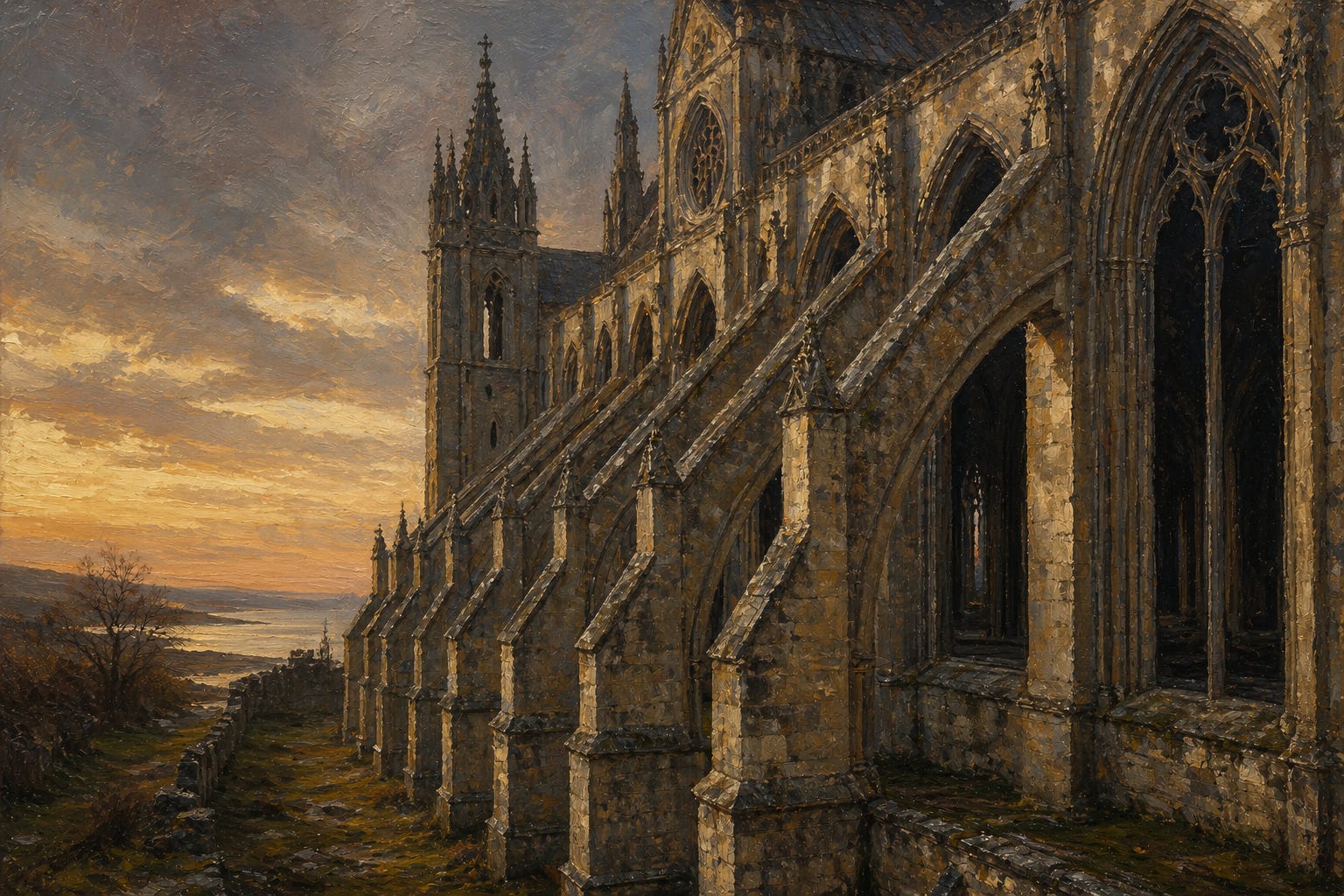
Finally, then, comes the line that clarifies what the list is for. Ki et ishei Hashem lechem Elokeihem hu makriv. Because he is the one who brings the fire-offerings, the bread of his God. The standards and the calling are spoken in the same breath. It’s not that he is holy because he keeps these rules. Rather, his life stands near something foundational, and a life that stands near something takes on a particular shape — and the rules are the buttresses that ensure contact with holiness carries the weight it deserves.
Which makes the standards of the Kohen feel different, I think, from the kind of religious limitation we sometimes default to imagining. They aren’t really about subduing anything. They’re more like a container, a way of being held. There’s something about being near kedusha that impacts how we should be. A kind of Malchut, the feeling that all this pageantry is meant to convey the importance of what’s happening here.
Held this way, the standards aren’t restrictions; they’re one version of what a life looks like from the outside when it’s being lived from the inside. But if you detach them from the calling, they do start to look strange — fussy, ornamental; a costume. But inside the calling, they hardly feel like rules at all.
The trouble is that the buttresses meant to hold up a building can outlast it. The structure they were meant to steady gets quietly emptied — not knocked down, just hollowed out — and the buttresses stay where they were, intact and well-maintained. The outward manifestation of the inner life is slowly mistaken for the goal because it is clearly trackable.
It’s not that we lose the appreciation for the principles which give the outward trappings their weight; it’s something subtler. The appearances become their own answer. The inner life we can only hint at gets overshadowed by the clarity of objective metrics.
And there’s something relatable about confusing the two. The Kohen who maintains his beard, his marriage choices, and his bearing, isn’t doing anything different from the Kohen who maintains them with the focus on the internal avodah still vivid in front of him. The form is identical. What’s different is the interior, and from the outside, there’s no way to tell the two apart. Maybe sometimes from the inside, too.
I notice this in my own avodah more than I'd like. There are stretches where I can't quite tell if the trappings and guards I'm keeping are still holding something, or if all I’m protecting is an ornate and empty room.
I think this is what makes the drift so hard to notice from within it. There isn’t a moment when you cross a line. There’s just a slow re-centering. The standard, which was meant to hint at something deeper, becomes the thing being held up. The form, which was a way of standing close to something, becomes what you’re orienting to. And once that’s happened, the objective standard starts asking different things of you. It starts asking to be defended for its own sake. It starts producing a kind of certainty that the original internal calling never produced, because callings are unsteady, they ask you to keep questioning. A well-kept form gives you the feeling of having already arrived.
The Torah knows this can happen. There are places where the tradition seems to be quietly anticipating that the protective measures might one day suffocate what it was meant to carry — and writing in, ahead of time, the permission to set the fences down.
The clearest place this shows up is also in the Mikdash, with tumah hutrah b’tzibur. The general rule is that ritual impurity disqualifies a Korban — the entire system of the Mikdash is organized around the integrity of that boundary, and the standards that protect it are not optional. But when the whole community is in a state of tumah, and the Korban Tziburmust still be brought, the rule yields. The impurity is set aside. Not because the standard has stopped mattering, but because the function the standard was protecting, the integrity of the community’s offering, cannot itself be suspended. The fence comes down so that the building it was guarding can stay standing.
This is encoded directly into the system. It isn’t an exception someone argues for in a moment of crisis. It’s written in. The Torah, or the halachic structure that flows from it, seems to anticipate that there will be situations where holding the standard rigidly would betray what the standard was for, and it builds the flexibility into the architecture itself. The standard and its limits are part of the same design.
But there’s something more broad in its application. The Gemara says Pa’amim shemevatlah shel Torah zehu kiyumah, sometimes the nullification of Torah is itself its fulfillment. The verse the Gemara hangs this on is eis la’asot la’Hashem heferu Toratecha. Translated directly it means, “It is a time to act for God, for they have nullified Your Torah,” but it is read by the Gemara as a near-inversion. That there are moments when to act for God means to shred something. The outward protective form must be broken, in that moment, for what the form was meant to serve.
The paradigm case the Gemara points to is Moshe at the foot of Har Sinai after the Golden Calf. He comes down with the luchot, the first set of which were written by God, and he sees the people at the calf. And he breaks them. He doesn’t carry them down to the people, he shatters them at the base of the mountain. And the Gemara, reading this generations later, says yishar kochacha sheshibarta. Well done that you broke them. The breaking was the keeping, and he goes and receives a second pair.
I think it’s worth sitting with how strange this is. The luchot were not a fence. They were the thing itself. And still — in that moment, in front of that people — bringing them intact would have meant something other than what they were for. Moshe’s reading of the moment was that delivering the form would betray the substance. So he broke the form, and the tradition, looking back, says he was right.
This is the pattern the tradition keeps returning to. Not that the standards don’t matter — they do, foundationally — but that the standards exist in service of something, and there are moments when the most faithful thing is to recognize that the form has turned, in this particular instance, against what it was configured for. Tumah hutrah b’tzibur is the systemic version, encoded ahead of time. Moshe at the foot of the mountain is the version that requires real-time judgment, in a moment, with everything at stake.
But this is a high bar. Moshe is Moshe. The reading of eis la’asot as license rather than as terror — as permission rather than as the heaviest possible weight — is almost always a misreading. The tradition isn’t offering an escape clause. It’s acknowledging, soberly, that there are rare moments where the form must yield, and that recognizing such a moment is itself one of the hardest forms of fidelity. Most of the time, what feels like eis la’asot is something else wearing its clothes.
There is a story the Gemara tells in Gittin, this idea is painfully clear there.
A man in Yerushalayim makes a feast. He has a friend named Kamtza and an enemy named Bar Kamtza. He sends his servant to invite Kamtza, but the servant brings Bar Kamtza by mistake. The host walks in, sees his enemy at the table, and tells him to leave. Bar Kamtza offers to pay for what he’s eating. The host refuses. He offers to pay for half the feast. Refused. The whole feast. Refused. The host pulls him up and throws him out. And the Gemara, almost in passing, tells us that the Chachamim were there. They saw it. They said nothing.
Bar Kamtza leaves humiliated, and reads their silence as endorsement — since the rabbis sat there and didn’t object, they must have been fine with it. So he goes to the Roman authorities and tells them the Jews are rebelling. The Romans send a Korban to be offered in the Beit HaMikdash as a test of loyalty. On the way, Bar Kamtza makes a small blemish in it — a mum that disqualifies it by Jewish law but not by Roman standards.
And now the Chachamim are facing a real question. Accept the Korban, and they signal that blemished offerings can be brought, eroding the standards of the Mikdash from within. Reject it, and they offend Rome, with consequences they can see clearly enough. Some suggest killing Bar Kamtza so he can’t report back. Rabbi Zechariah ben Avkulas objects to both. If we accept the offering, people will say blemished Korbanot are valid. If we kill Bar Kamtza, people will say one who blemishes a Korban is killed. So nothing is done. The Korban is refused. Bar Kamtza reports back. The Romans come. The Gemara, recording all this, gives one of the most devastating sentences in the entire Talmud: anvetanuto shel Rabbi Zechariah ben Avkulas hechrivah et beiteinu v’sarfah et heichaleinu v’higlatnu mei’artzeinu. The humility of Rabbi Zechariah ben Avkulas destroyed our House and burned our Sanctuary and exiled us from our land.
The word anvetanuto here is a hard one to translate. It can’t quite mean humility in the ordinary sense, because what Rabbi Zechariah did wasn’t humble in the way we’d recognize. He held the line. He refused both options as too risky. The commentators have pulled at this word in different directions for centuries. Some read it as scrupulousness, he was too careful, too unwilling to issue a ruling that might be misunderstood. Some read it as a kind of moral timidity dressed as caution, a refusal to take responsibility for a hard call, presented as deference to the standard. Some read the word as ironic, the Gemara’s quiet commentary on a man who couldn’t see that his careful neutrality was itself a decision with consequences. The Gemara doesn’t tell us which reading is right. It doesn’t tell us what Rabbi Zechariah should have done. It just tells us what happened, and lets the outcome of the verdict, the destruction of the Mikdash and Galut, sit there.
I think this is what makes the story so hard to read. Rabbi Zechariah wasn’t wrong about the halacha necessarily. The concerns he raised were real. Accepting the blemished Korban would have set a precedent. Killing Bar Kamtza would have set a different one. He was thinking carefully about the integrity of the system. And the Gemara, looking back, says: this careful thinking, in this moment, was the thing that destroyed the system he was trying to protect. It’s the reverse of Moshe at the foot of the mountain. Rabbi Zechariah sees the moment with the Roman Korban and reads it as one where any deviation from the form would erode the substance. They are facing structurally similar choices. They make opposite calls. And the tradition tells us, in Moshe’s case, yishar kochacha sheshibarta — and in Rabbi Zechariah’s case, hechrivah et beiteinu.
The Gemara doesn’t say Rabbi Zechariah should have been Moshe. It would be obscene to suggest such a thing. What it says is harder. It says: a man who was careful, who was learned, who was scrupulous about the standards of the Mikdash, made a judgment in a moment where everything depended on the judgment, and the judgment was wrong, and the House came down. And it doesn’t tell us how he could have known. It just tells us what his caution cost.
But the intense decision moments, while critical, are often the wrong place to look.
The Gemara doesn’t begin its account with the deliberation of the Rebbeim. It begins at a dinner table. A man humiliates his enemy in front of a room of people who could have intervened. The Chachamim were there. They saw it happen. And they let it happen. The story we read as the story of the Mikdash’s destruction begins, in the Gemara’s own telling, with a quiet failure of kavod habriyot — and the Chachamim’s silence is part of that failure, not separate from it.
It’s worth considering how strange this framing is. The Gemara could have started the story with Bar Kamtza’s denunciation to the Romans. It could have started with the blemished Korban. These are the dramatic moments, the moments where the destruction is set in motion by visible decisions. But the Gemara doesn’t start there. It starts at a table, with humiliation, and with rabbis who said nothing.
I don’t think the Gemara is telling us that the dinner table failure caused the destruction in any direct sense. But by starting where it starts, it is telling us where the failure first became noticeable. The standards of kavod habriyot — the standards that protect a person from being publicly stripped of their dignity at someone else’s table — were treated as soft. As social. As the kind of thing you didn’t make a scene about. Not unimportant, exactly, but not the kind of standard that a learned man interrupts a feast to enforce.
And then, weeks or months later, the same Chachamim — or others like them — found themselves in a room where the standards of the Mikdash had to be defended with extraordinary precision, because every move had consequences. And it was in that room, with those stakes, that the careful judgment came undone.
The connection between these two moments isn’t causal, it’s something more like a pattern of attention. The standards a community treats as serious are the standards that get defended in real time. The standards a community lets slide are the standards whose erosion accumulates, until one day the situation that care would have prevented has already arrived, and now the only question is what to do about it.
By the time you’re standing in front of the blemished Korban, much has already been decided. Not by you, in that room, in that moment. But by everyone who, in smaller rooms, on quieter days, decided that this kind of standard or that kind of standard wasn’t worth a hard word at the wrong moment.
This is the thing the Gemara seems to be pointing at by starting at the table. Kavod habriyot and kedushat hamikdash are not separate systems. They are part of one configured life — the same life Emor describes in the Kohen, where every detail of how a person carries himself is part of the form a calling takes. You cannot hold one register and let the other go. The standards that get treated as merely social are the ones that, when allowed to thin, hollow out the standards that don’t yet seem to be in danger.
The deliberation room is downstream. The dinner table is upstream. The tragedy of Rabbi Zechariah is real, and the Gemara doesn’t take it back. But the Gemara also tells us where the story actually started.
Which leaves us with the question of how to live in a tradition that asks for both. The standards have to be held; they are the form a configured life takes. But the standards have to be held lightly enough that, in the rare moments when the form turns against the substance, the form can yield. Eis la’asot is real. Moshe broke the luchot. The tradition doesn’t shy away from it.
But I think the lesson Bar Kamtza leaves us with isn’t about how to recognize those moments. It’s about how rarely we should expect to be in them. The dramatic standards take care of themselves, mostly. They’re loud, visible, and defended by everyone’s attention. It’s the smaller standards that quietly hold everything else up. The hard word at the dinner table. The small refusal to let something pass when letting it pass would be easier than naming it.
These are the standards that, when kept, mean the question of eis la’asot rarely has to be asked. And when not kept, the big question becomes, eventually, the question we are left with. The question you’re forced to ask because the upstream work was not done.
The Chachamim at Bar Kamtza’s deliberation were not facing a moment that called for bitulah shel Torah zehu kiyumah. They were facing the consequences of a moment, much earlier, when no one stood up at a table.
The way to protect what is foundational, it seems, is not to wait for the foundational moment. It’s to be diligent with what looks small. To protect the inner principles, one cannot split which ones they care about.