
ה׳ שפתי תפתח
A Meditation on Being and Becoming

I always just go back and forth. Three steps away, three steps back. Emptying space for me to refill again, hopefully this time with presence, not perfunctory mouth-thing.
Always the same mantra, the words meant to be declarative but, more often than not, decorative. ה׳ שפתי תפתח ופי יגיד תהלתך, open my lips so my mouth may say your praise. This line is the start of תפילה, the start of official prayer. It is the boundary we pass through in our most intimate moments with God in our day to day mundanity.
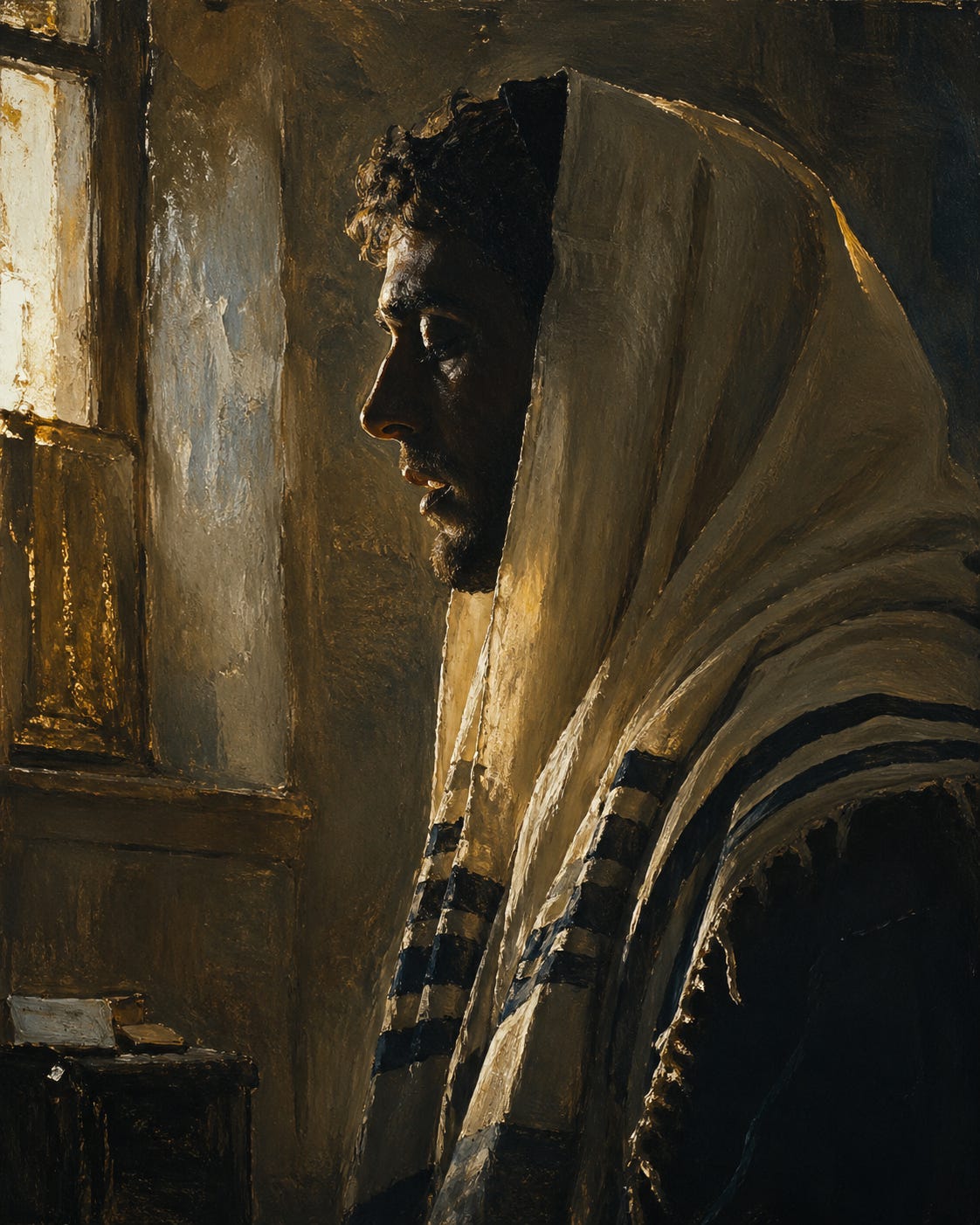
A prayer that asks for what exactly? A prayer for intention? For possibility? At first quick glance it seems we are asking for the ability to focus, but the words are much more embodied than that. Maybe the actual physical ability to move our lips? Not really either, because we aren’t the ones who move them. God does. So for God to intervene on our behalf and move us to prayer? Maybe, but he does the opening, not the actual praying because then our mouth takes over. So maybe for God to open the tap, so to speak? For God to open our lips and assist us in overcoming the hurdle of us needing to start praying? Maybe that’s closer, but then what is the word תהלתך, your praise? Is it our prayer or yours?
In short, what is us here and what is God? Are we praying for our agency or to help God move us aside and sit with His?
If we are praying to be moved out of the way then to what end? If we thin ourselves than are we truly present? On the other hand, what does it mean to be truly present with the foundation of reality and God that transcends it? I remember times when I have been fully present with what is in front of me. Whether it’s with my crying son, a client on the verge of tears, a beautiful sunset, or maybe a hearty bowl of soup. There are moments we both feel fully here and yet, like something has been stripped away.
The angst we feel, the existential kind, the kind that tells us that we are limited and that our time will run out, can be a great motivator. It can also cripple us. We can try and try to impose agendas on the canvas of reality, more often than not our successes are mixed. Presence. The showing up here and now. That’s something special. The more we strip away the more we see who we are and what is here. In the style of Rollo May, we gain the capacity to sit in tension without simplifying or collapsing from it. To act from chosen freedom rather than reactivity. To be liberated from the distortions of our own ego and needs. We get in touch with what’s under the surface of our fear and become capable of seeing what is actually in front of us. From here flows creativity and joy.
When we turn that outwards we see that same possibility in people. We can move away from seeing everyone as instruments in the tool box we have as we build our own vision of the universe. We can instead see the depths of the other person, or at least begin to understand the extent to which that person has depths. In meeting the very real other, we begin to appreciate the beauty inherent in them. When we can appreciate ourselves, the integration between who I am and the very real fact of my limits, then we can begin to truly see others for who they are, instead of needing to categorize them based on how they can serve me. When our fortified self can be relaxed enough to perceive without fear, we can stand on our own two feet opposite another and see them for them.
However, these moments of clarity are fleeting. Much like the prophets of old who spent years preparing and making the way possible, whether in the end prophecy arrives isn’t dependent on them. We may be able to build the field, but the critical impetus of growth must come from above. No matter how hard we try, we can’t quench thirst without rain from above. Moments like the ones we’ve described, where reality seems simple, and at the same time unimaginably deep, come like lightning. Sometimes whether we have prepared or not.
ה׳ שפתי תפתח ופי יגיד תהלתך, God do the work for me and give me one of those moments in this prayer. Grant me the chance to really pray.
Heschel says similarly. Prayer is gift from God, not our achievement. How motivated we are does not bring potential into actuality. Suffering does not produce prayer; our response to it merely clears the ground. “The idea of prayer is based upon the assumption of man’s ability to accost God, to lay our hopes, sorrows, and wishes before Him. But this assumption is not an awareness of a particular ability with which we are endowed…Contact with Him is not our achievement. It is a gift, coming down to us from on high like a meteor, rather than rising up like a rocket.” When we become thin enough to see beyond ourselves we actually gain the ability to channel something beyond us. We all contain the natural ability to pray from the place of honest, transparent, God awareness. It is our prayer, but our prayer purified by God of the various blockages and filters that are us. The deepest aspiration is not to master our power of prayer, but to be looked upon and remembered by God. To be a thought of God. ה׳ שפתי תפתח, the encounter is not mine to summon. Open my lips unto a meeting I cannot generate.
Yet, why then say anything? If we do all the work, but cannot be sure the peak will be reached then to what avail is all the effort? It seems I’m praying for something that I can’t work towards. But the work I do is real. Shall I forever be asking, as the empty-bowled Oliver Twist did, “please sir, may I have some more?” Shall I fool myself into thinking passivity is holy? Is waiting all we are meant to do?
Are we not about to launch into 19 asks? 19 moments where I am meant to recognize a fault in myself, the Jewish people, and/or reality? Why, in the opening line of the prayer, claim I need to just wait doe eyed for God to come and then rub my face in the various things I am unable to impact but clearly can feel the pain of? Does Rav Soleveitchik not discuss how Kedusha is man made? How Eretz Yisrael is holy because of the Jewish people’s conquests? How when we designate something as Kadosh its own inherent status in reality shifts? We believe in the power of man to change the existential reality of lived physicality!
Do we not have פסוקים which call us to higher ideals of action? צדק צדק תרדוף we are told! בצדק תשפט עמיתך! Amos says passionately “Let justice roll down like waters, righteousness like a mighty stream.” Judaism is not a passive religion waiting on God to fix His world! Was not בצלאל praised as a man of great creativity as he diligently followed the minutiae of building the Mishkan.
Even Rollo May had three stages before the transcendent fourth. His fourth state did not come from nowhere. There were three stages of growth before it. Buber himself admits that we cannot truly be forever in the relational otherness, of I-Thou, we need to see the world through instrumentality. We try and build the building because that is what we must do. Maybe we must strive, even as we acknowledge that the transcendent peak is beyond what we can claim is within our power. שפתי תפתח, open my lips into the labor I am about to undertake. Help me build the structure that this davening is trying to create.
So then are we left with outstretched arms reaching for the ephemeral possibility of contact? Is the goal of building ourselves purely to become a receptacle? Much like the Mishkan? Moshe and בצלאל built the Mishkan. Every measurement, every detail. Va’yechal Moshe et hamelacha, he finished the work. And then kavod Hashem malei et hamishkan, it was filled by God. The filling couldn’t have been built. There wouldn’t have been filling without the effort of the building. The exact measurements were the circuitry God filled. But what would have been if God didn’t fill the mishkan? What happens to us when we don’t receive after working so hard?
Part of me is exhausted by it. Every dry spell where no rain or meteor falls hints at a lack of structural integrity. Inadequate building. There is a weight of depression in the constructive drive. תפילה as performance measured by its product. From passiveness to too much responsibility, we must walk the tightrope. Looking down into the valley below with dread and inevitability we can’t shake.
Then I remember all the work, the pride I have in it, and remember that is why there are levels. The building is important work in and of itself. We build ourselves into the kind of person able to uncover what lies in wait within us. We build ourselves because the world does need fixing, there is human work to do. Contact with God may be the gift we long for, but contact with this world is the responsibility we get our hands dirty with.
ה׳ שפתי תפתח, God open my lips. Get me started. ופי יגיד תהלתך, and I’ll make sure that the words I speak, the work I do, will be yours. It will be a living testimony to your grandeur, your strength, your truth. We bend our backs and ask for help with the labor. We do so with the humble bitter recognition that the contact will forever remain a gift. We launch into structured speech with the acknowledgment that what the speech reaches for is not produced by speaking.
We want the whole arc to be real this morning. For the davening to be not the performance of words but actual contact. For the lips to be opened onto Him, not just onto the siddur.
At the end of עמידה we say יהיו לרצון אמרי פי והגיון ליבי בתהלתך, have my words and wonderings/wanderings of my heart be wanted, have my building be worthwhile. ה׳ צורי וגואלי, God my rock, my foundational source of reality which guides my building, and my savior, who reaches down and gives my building its light.